
When South African entrepreneurs search for ways to build ecommerce website platforms, they often face a confusing landscape of pricing and promises. The reality is that affordable eCommerce website design in South Africa offers substantial advantages that extend far beyond the initial price tag, particularly for startups and small businesses ready to capture their share of a market projected to reach USD 61.5 billion by 2030[8].
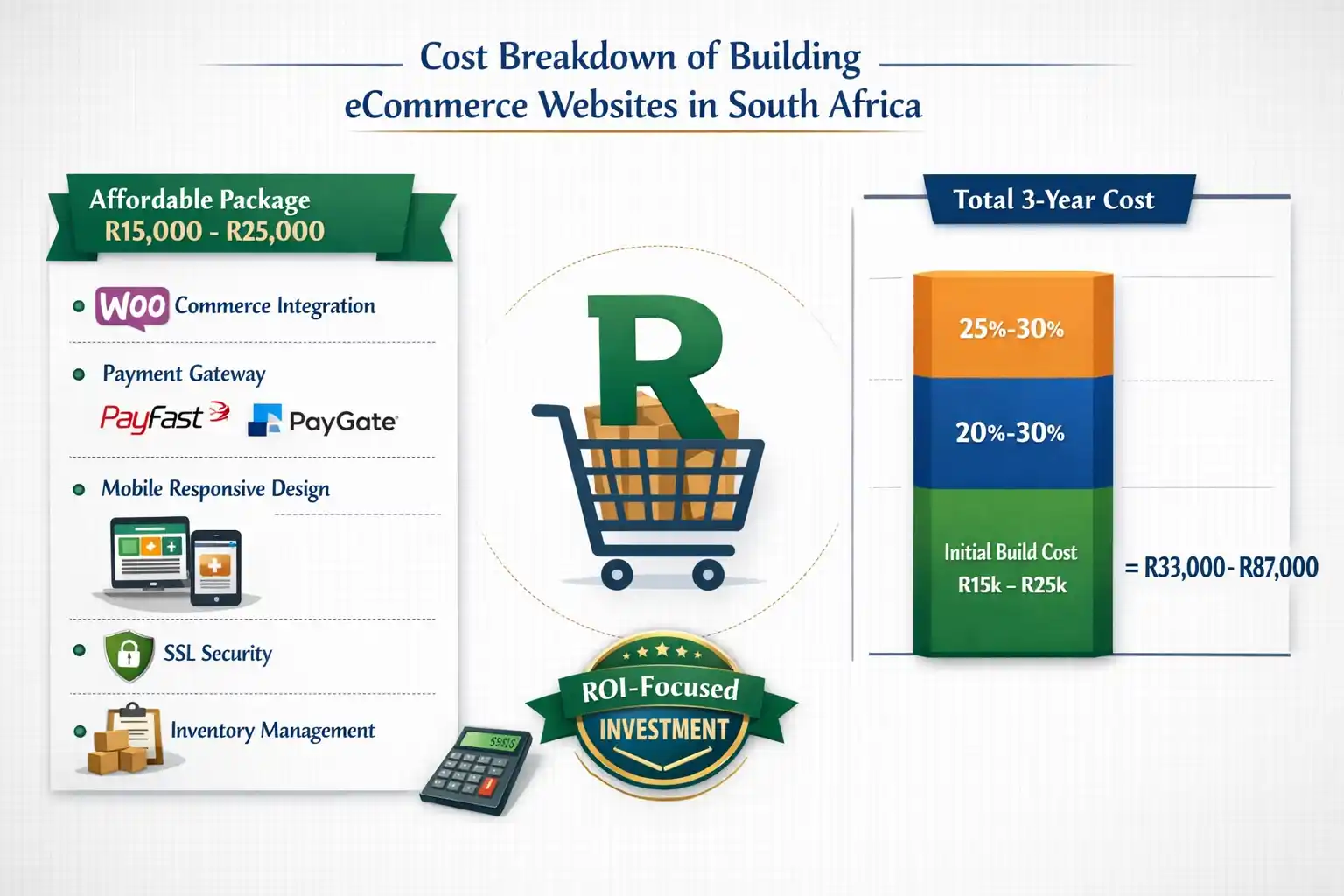
Affordable eCommerce website design in South Africa provides entrepreneurs with professional online selling platforms at R15,000–R40,000, including payment gateway integration, inventory management, and mobile optimization[2]. These solutions balance cost-effectiveness with essential functionality, allowing startups to enter a rapidly growing market (projected USD 61.5 billion by 2030) without excessive capital investment[8]. The key advantage lies not in minimal pricing but in maximizing return on investment through professionally built platforms that actually generate revenue.
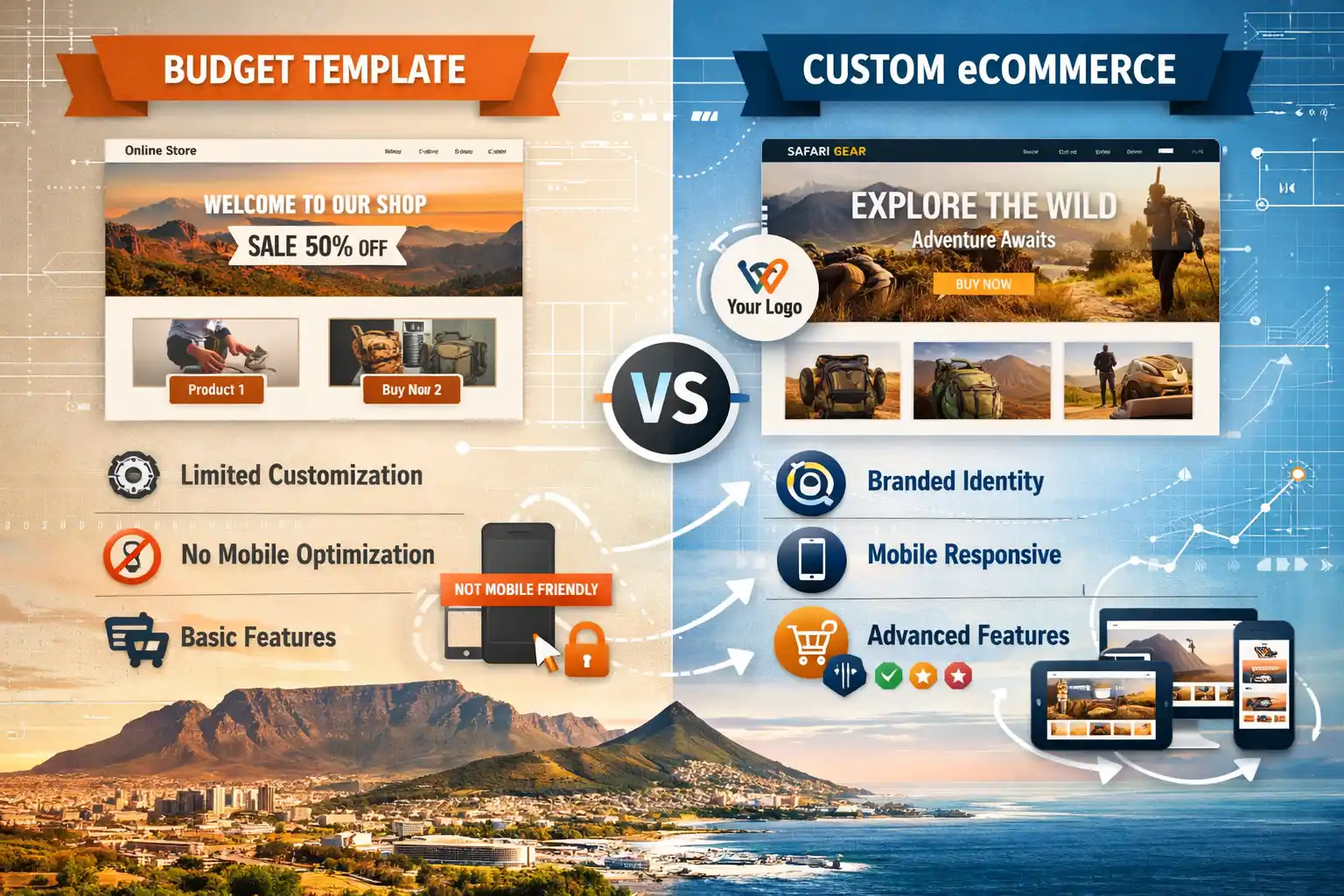
Affordable eCommerce website design occupies a distinct middle ground between basic templates and enterprise-level custom development. Professional eCommerce packages in the R6,000–R25,000 range deliver custom business websites with specialized functionality that template-only options (R3,000–R7,000) cannot provide[2].
Core differences include:
The pricing structure reflects these specialized requirements. While basic business websites cost R7,000–R20,000, eCommerce sites command R20,000–R50,000+ because they incorporate payment processing, security compliance, and inventory systems that brochure-style sites don't need[1][4].
Choose affordable professional eCommerce if: You need legitimate online selling capability with payment processing, have a product catalog requiring inventory management, and want a platform that can scale as your business grows. Avoid template-only options if you're building a serious revenue-generating business rather than testing a concept.
Building an eCommerce website in South Africa involves both initial development costs and ongoing operational expenses. Professional eCommerce websites cost R15,000–R40,000 for standard online stores with complete payment gateway integration, product management, and mobile optimization[2]. More sophisticated platforms range from R30,000–R120,000+ depending on complexity, custom features, and scale[3].
Initial development pricing tiers:
Price Range: R23,690+
What's Included: Product display, inquiry forms, no payment processing[1]
Price Range: R15,000–R25,000
What's Included: Payment gateway, basic inventory, mobile optimization[2]
Price Range: R30,000–R50,000
What's Included: Advanced features, custom design, multiple payment options[3]
Price Range: R50,000–R120,000+
What's Included: Complex integrations, custom functionality, scalability[3]
The hidden cost reality: A "R15,000 website" actually costs R33,000–R87,000 over three years when factoring in essential ongoing expenses[2]:
Common mistake: Focusing exclusively on initial build cost while ignoring total cost of ownership. A slightly higher upfront investment in quality hosting and maintenance infrastructure prevents expensive emergency fixes and lost revenue from downtime.
Developer rates context: South African web developers charge R200–R350 per hour on average[4], which helps explain custom development costs and provides a benchmark for evaluating ongoing modification expenses.
Return on investment for eCommerce websites depends more on execution quality than initial cost. Industry analysis demonstrates that a R50,000 site generating R500,000 annually provides superior value to a R5,000 site generating no revenue[3]—a principle that shifts focus from price minimization to revenue maximization.
ROI calculation framework:
For a R25,000 eCommerce site with R2,000 monthly operating costs:
Market opportunity context: South Africa's eCommerce market reached USD 38.5 billion in 2025 and projects to USD 61.5 billion by 2030[8], indicating robust growth that supports new entrants. With over 80% of South Africans active internet users in 2026[7], the addressable market for online retail continues expanding.
Revenue drivers that justify investment:
Choose higher-tier packages if: Your product margins support it, you're entering competitive markets requiring professional presentation, or you have existing customer bases ready to transition online. The R30,000–R50,000 range often delivers optimal ROI for established small businesses moving online.

Startups require professional eCommerce features not for prestige but for functional legitimacy and customer trust. Professional packages typically include WooCommerce or Shopify integration, payment gateway setup, inventory management, shipping integration, mobile optimization, and comprehensive security features[3]—each serving specific business requirements.
Essential professional features and their purposes:
Payment gateway integration (PayFast, Paygate, Peach Payments):
Inventory management systems:
Mobile optimization:
Security features:
Startup packages with professional quality are available from R10,000, with companies offering affordable startup packages and fast turnaround times that meet emerging business needs[6]. These entry-level professional options provide legitimate eCommerce capability without enterprise-level investment.
Common mistake: Launching with catalog-only sites (quote basket functionality) that require customers to email for purchases. This friction dramatically reduces conversion rates compared to seamless checkout processes. If you're selling products, invest in actual payment processing from launch.
Affordable eCommerce platforms built with scalability in mind allow businesses to grow without expensive rebuilds or platform migrations. Properly structured sites accommodate increased traffic, expanded product catalogs, and additional functionality through modular architecture rather than complete redesigns.
Scalability factors in affordable packages:
Platform selection:
Database architecture:
Hosting infrastructure:
Feature addition capability:
Growth path example: A startup launches with 50 products, basic payment gateway, and standard shipping (R18,000 initial build). Year two adds 200 products, integrates with Xero accounting, and implements email marketing automation (R8,000 in enhancements). Year three expands to 500 products, adds subscription box option, and integrates marketplace selling (R12,000 in additions). Total three-year investment: R38,000 versus R60,000+ for complete rebuild approaches.
Choose platforms with clear upgrade paths rather than proprietary systems that lock you into single vendors. WooCommerce and Shopify both offer extensive ecosystems that support business evolution without platform abandonment.
Monthly maintenance costs for eCommerce sites average R1,500+ per month for actively marketed online stores, covering hosting, security updates, backups, and support[4]. These predictable, manageable ongoing expenses represent necessary operational costs rather than optional luxuries.
Monthly operational expense breakdown:
Hosting (R500–R2,000/month):
Security and maintenance (R500–R1,000/month):
Domain and email (R150–R500/month):
Payment gateway fees (variable):
Optional but recommended (R500–R2,000/month):
Annual costs to anticipate:
Total realistic monthly budget: R2,000–R5,000 for small to medium eCommerce operations, increasing with traffic, transaction volume, and feature requirements.
Budget planning tip: Set aside 15%–20% of monthly revenue for operational costs and improvements. This percentage naturally scales with business growth while ensuring adequate investment in platform maintenance and enhancement.
South African market conditions in 2026 create favorable circumstances for eCommerce investment, with high internet penetration, growing digital payment adoption, and market growth trajectories that support new online retailers.
Market opportunity indicators:
Internet penetration: Over 80% of South Africans are active internet users in 2026, with substantial daily engagement creating strong demand for eCommerce solutions[7]. This penetration rate provides addressable markets across demographic segments and geographic regions.
Market size and growth: The South African eCommerce market reached USD 38.5 billion in 2025 and projects to USD 61.5 billion by 2030[8], representing compound annual growth that supports both established players and new entrants. This expansion indicates increasing consumer comfort with online purchasing and digital payment methods.
Payment infrastructure maturity: South African payment gateways (PayFast, Paygate, Peach Payments) offer localized solutions with competitive pricing, instant EFT options, and mobile payment integration that reduce friction in the checkout process. This infrastructure development removes technical barriers that previously complicated online selling.
Mobile commerce dominance: The majority of South African internet users access online content via smartphones, making mobile-optimized eCommerce essential rather than optional. Affordable eCommerce packages that include responsive design address this fundamental market requirement[7].
Competitive landscape opportunities:
Economic factors supporting eCommerce:
Enter the market if: You have product-market fit, understand your target customer's online behavior, and can commit to consistent marketing efforts. The market growth supports new entrants, but success still requires execution quality beyond just having a website.
Entrepreneurs evaluating affordable eCommerce packages should assess functionality completeness, total cost of ownership, scalability potential, and vendor support quality rather than focusing exclusively on initial price.
Essential package components checklist:
✅ Payment processing capability
✅ Product management system
✅ Mobile optimization
✅ SEO fundamentals
✅ Shipping integration
✅ Customer account functionality
✅ Administrative features
Red flags to avoid:
Questions to ask vendors:
Package comparison approach: Request detailed quotes from 3–5 providers, ensuring each quote itemizes the same features for accurate comparison. The lowest price often excludes essential components that appear as "add-ons" later.
How much does it cost to build an eCommerce website in South Africa in 2026?
Professional eCommerce websites in South Africa cost R15,000–R40,000 for standard online stores with payment gateway integration, inventory management, and mobile optimization[2]. More complex platforms range from R30,000–R120,000+ depending on custom features and scale[3]. Total three-year cost of ownership reaches R33,000–R87,000 when including hosting and maintenance[2].
What's the difference between affordable and cheap eCommerce websites?
Affordable eCommerce websites (R15,000–R25,000) provide professional functionality including payment processing, inventory systems, and custom design[2]. Cheap template sites (R3,000–R7,000) offer basic product displays without payment integration, limited customization, and poor SEO performance[2]. Affordable solutions balance cost-effectiveness with revenue-generating capability.
Can startups build eCommerce websites for under R20,000?
Yes, startups can access professional eCommerce packages from R10,000–R20,000 that include essential functionality like payment gateways, basic inventory management, and mobile optimization[6]. These entry-level professional options provide legitimate online selling capability suitable for businesses with limited initial capital and straightforward product catalogs.
What ongoing costs should I budget for an eCommerce website?
Budget R2,000–R5,000 monthly for eCommerce operations, including hosting (R500–R2,000), maintenance and security updates (R500–R1,000), domain and email (R150–R500), and optional tools like email marketing (R300–R800)[4]. Payment gateway fees add 2.9%–3.5% per transaction. Set aside 15%–20% of monthly revenue for operational costs.
Which eCommerce platform is best for South African businesses?
WooCommerce suits businesses wanting maximum customization and control, with extensive plugin options and lower ongoing costs. Shopify offers managed hosting, built-in scalability, and easier setup for non-technical owners but requires monthly subscriptions. Both support South African payment gateways and provide professional eCommerce functionality suitable for small to medium businesses.
How long does it take to build an eCommerce website?
Professional eCommerce websites typically require 4–8 weeks from project start to launch, including planning, design, development, content population, testing, and payment gateway setup. Rushed timelines compromise quality, while projects extending beyond 12 weeks often indicate scope creep or vendor capacity issues. Fast-track options may be available for simplified projects.
Do I need a business registration to accept online payments in South Africa?
Yes, South African payment gateways (PayFast, Paygate) require business registration documentation and bank account verification before approving merchant accounts. Sole proprietors can register with CIPC and use business bank accounts. This requirement ensures payment security and regulatory compliance but adds 1–2 weeks to the setup timeline.
Can I start with a basic site and upgrade later?
Yes, if built on scalable platforms like WooCommerce or Shopify. Start with essential features (payment processing, basic inventory, mobile optimization) and add functionality (subscriptions, multi-currency, marketplace integration) as revenue grows. Avoid proprietary platforms that require complete rebuilds for upgrades. Budget R5,000–R15,000 for significant feature additions.
What payment methods should my eCommerce site accept?
South African eCommerce sites should accept credit/debit cards (Visa, Mastercard), instant EFT, and mobile payments at minimum. PayFast and Paygate provide these options in single integrations. Consider adding SnapScan, Zapper, or international gateways (PayPal, Stripe) if targeting specific customer segments or international markets.
How do I know if an eCommerce package is worth the investment?
Calculate potential ROI: divide projected annual profit by total first-year investment (build cost + 12 months operations). ROI above 100% indicates strong value. Verify the package includes payment processing, inventory management, mobile optimization, and ongoing support. Request client references and review portfolio examples to assess vendor capability.
What's the biggest mistake entrepreneurs make with eCommerce websites?
Focusing exclusively on minimizing initial cost rather than maximizing revenue potential. A R5,000 template site that generates no sales provides zero ROI, while a R25,000 professional site generating R300,000 annually delivers 1,100% first-year ROI[3]. Invest in functionality that enables actual selling (payment processing, mobile optimization, professional design) rather than just online presence.
Do I need technical skills to manage an eCommerce website?
No, modern eCommerce platforms (WooCommerce, Shopify) provide user-friendly dashboards for adding products, processing orders, and managing inventory without coding knowledge. Basic computer skills and willingness to learn platform-specific processes suffice. Budget for vendor support (R500–R1,000/month) for technical issues, updates, and troubleshooting beyond routine management.
Affordable eCommerce website design in South Africa represents a strategic investment opportunity for entrepreneurs and startups in 2026. With professional packages available from R15,000–R40,000, businesses can access complete online selling platforms including payment processing, inventory management, and mobile optimization without excessive capital requirements[2]. The key advantage lies not in minimal pricing but in maximizing return on investment through professionally built platforms that generate actual revenue.
South Africa's eCommerce market trajectory—from USD 38.5 billion in 2025 to projected USD 61.5 billion by 2030[8]—combined with over 80% internet penetration[7] creates favorable conditions for new online retailers. Success requires focusing on total cost of ownership (R33,000–R87,000 over three years)[2] rather than initial price alone, and selecting scalable platforms that support business growth without expensive rebuilds.
Actionable next steps:
The entrepreneurs who succeed in South African eCommerce don't necessarily spend the least on website development. They invest strategically in platforms that actually sell products, serve customers effectively, and scale with business growth. When you're ready to build an eCommerce website, prioritize revenue-generating capability over price minimization, and select partners who understand the difference between affordable and cheap.
[1] What Is The Cost Of Creating A Website In South Africa 2026
[2] Website Cost Guide South Africa
[3] Website Design Costs South Africa
[4] What Is The Cost Of Creating A Website In South Africa
[6] Best Website Design Companies South Africa 2026
[7] Top 5 Affordable Digital Marketing Strategies For In 2026
[8] Ecommerce Payment Statistics South African Businesses Should Track
Thinking about selling online?
We build affordable, professional eCommerce websites in South Africa from R6,000 designed to grow with your business.
👉 Get in touch and let’s chat.